Lazy ListBox
An asset by spinalcord
Install Asset
Install via Godot
To maintain one source of truth, Godot Asset Library is just a mirror of the old asset library so you can download directly on Godot via the integrated asset library browser

Quick Information


Lazy ListBox
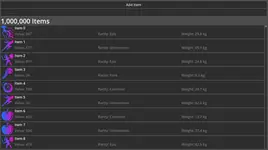
This Control allows you to handle thousands of items by recycling a small pool of UI elements and only displaying what's currently visible on screen instead of creating individual controls for every data entry, creating the illusion that you're scrolling through thousands of actual items while maintaining optimal performance and minimal resource usage.
Supported Engine Version
4.4
Version String
1.1.3
License Version
MIT
Support Level
community
Modified Date
4 months ago
Git URL
Issue URL

LazyListBox for Godot 4.4+
A high-performance List-Box control that can handle thousands of items by recycling a small pool of UI elements and only displaying what's currently visible on screen instead of creating individual controls for every data entry, creating the illusion that you're scrolling through thousands of actual items. Leave a Star if you will ⭐
Features
- Lazy loading items
- Auto-calculation of visible items (Or use a fixed value)
- Synchronized scrollbar
- Focus management with keyboard navigation
- Recycling/Caching items
Installation
- Download the plugin from the Asset Library or GitHub
- Extract to your project's addons/ folder
Usage
Step 1: Create the LazyListBox
- Open your "Main Scene" and create a
CanvasLayer, then drop thelazy_list_box.tscninto it. - You will see a
LazyListBoxcontrol
Step 2: Prepare your Item Template
- Create an
item_template.tscn. Make sure you choose theButtontype in theNew Scenedialog. This will represent your item in theLazyListBoxlater. Add again a button to the newly createditem_template.tscnset theAnchor PresettoFull Rectif you will. (Now we have two Buttons, like this):
ItemTemplate (Button-Type)
└──Button (Button-Type)
Ensure: ItemTemplate is for this example a Button-Type.
[!TIP]
Recommended The root node in your ItemTemplate should be always a Button so that focus calls work properly.
Make sure the ItemTemplate node has:
- The
Flatproperty set totruein your inspector - has a minimum size that is not
0(Layout -> Custom Minimum Size ->Y > 0in your Inspector). For this example, useY=50.
Attach the following script (my_item_template.gd) to ItemTemplate-Button in item_template.tscn and look at the _on_button_down method to understand how we access the data:
# my_item_template.gd
extends Button # Change this to your preferend control type.

# Store the original data and index for later use
var item_data
var item_index: int = -1

@onready var button: Button = $Button

func _ready():
    assert(button != null, "Assign the button in the  `item_template.tscn` for this example.")
    focus_mode = Control.FOCUS_ALL
    # EXAMPLE: Access data
    button.button_down.connect(_on_button_down)

# EXAMPLE: Access data
func _on_button_down():
    # Print both the displayed text and original data
    print("Button clicked - Index: ", item_index, " Data: ", item_data, " Text: ", button.text)

# This is called by LazyListBox: to configure the item
func configure_item(index: int, data):
    item_index = index
    item_data = data
    button.text = str(data)  # Display the data as button text
Don't forget to assign the Button
ItemTemplate <---- Make sure your button below is assigned to `my_item_template.gd` script.
└──Button
Step 3: Assign your Item Template to the LazyListBox
- Open your "Main Scene" and select the LazyListBox node
- Look at your Inspector; there is a field called
Item Template - Drop your
item_template.tscninto that<empty>field or choose theitem_template.tscnmanually.
Step 4: Simple Test with Fake Data
- Open your "Main Scene", create a
Nodewherever you want, and attach the following script below. This script will generate 500 objects, but you can go much higher.
extends Node

@export var lazy_list: LazyListBox

func _ready():
    assert(lazy_list != null, "Assign the lazy_list control! It's usually the lazy_list_box.tscn you dropped in your scene.")
    # Create simple test data with 500 items
    var test_data = []
    for i in range(500):
        test_data.append("Item " + str(i))
    # Set the data
    lazy_list.set_data(test_data)
Public API Methods
Basic Operations
set_data(data_array: Array)- Set the data for the listrefresh()- while configure_item can refresh the current item.refresh()can "refresh" the entire list.[!IMPORTANT]
refresh()only works for modifying existing data objects, not for adding/removing items from the array - useset_data()for array size "refresh" changes.scroll_to_index(index: int)- Scroll to specific data indexscroll_to_end()- Scroll to the end of the list
Focus Management
focus_item_at_data_index(index: int)- Focus item at data indexset_focus_preservation(enabled: bool)- Enable/disable focus preservationget_virtual_focused_index() -> int- Get currently focused data indexis_list_focused() -> bool- Check if list has focus
Configuration
set_auto_calculate_visible_count(enabled: bool)- Toggle auto-calculationset_manual_item_height(height: float)- Set manual item heightget_visible_range() -> Vector2i- Get range of visible indices
Requirements
- Godot 4.4+
- Your item template must implement:
configure_item(index: int, data)method
Troubleshooting
Problem: Items appear too small or overlapping
- Solution: Set Custom Minimum Size Y > 0 in your item template's root node. Lower
Yvalue will result in more displayed items.
Problem: Focus not working
- Solution: Use a Button as layout element. Activate
Flateif you will use a layout in it
Problem: I see no items
- Solution: You propably forget to add items. Look at
Step 4. Or it's layout problem: Then make sure you followedStep 2.
This Control allows you to handle thousands of items by recycling a small pool of UI elements and only displaying what's currently visible on screen instead of creating individual controls for every data entry, creating the illusion that you're scrolling through thousands of actual items while maintaining optimal performance and minimal resource usage.
Reviews
Quick Information
Lazy ListBox
This Control allows you to handle thousands of items by recycling a small pool of UI elements and only displaying what's currently visible on screen instead of creating individual controls for every data entry, creating the illusion that you're scrolling through thousands of actual items while maintaining optimal performance and minimal resource usage.
Supported Engine Version
4.4
Version String
1.1.3
License Version
MIT
Support Level
community
Modified Date
4 months ago
Git URL
Issue URL