Godot - DTag
An asset by Daylily
Install Asset
Install via Godot
To maintain one source of truth, Godot Asset Library is just a mirror of the old asset library so you can download directly on Godot via the integrated asset library browser



Quick Information


Godot - DTag
DTag, a tool for creating tag like "GameplayTag" in Unreal Engine.NOTE: This project is still under development, it may undergo significant changes in the future.DTag,为 Godot 提供一个类似 Unreal Engine 中 GameplayTag 的 Tag 机制。注意:该项目仍处于开发中,未来可能会发生巨大变化。
Supported Engine Version
4.5
Version String
1.2.0
License Version
MIT
Support Level
community
Modified Date
1 month ago
Git URL
Issue URL
Godot - DTag

Godot-DTag provides a Tag mechanism similar to Unreal Engine's GameplayTag for Godot.
Note: This project is still under development and may undergo significant changes in the future
Features
- The essence of DTag is
StringName. - Defined through text files (with ".dtag" extension), providing syntax highlighting and syntax checking in Godot's script editor.
- Provides editor tools to generate definition scripts, and supports custom code generators to generate definition code for different languages (such as C#).
- Provides inspector plugins for selecting Tag or Tag Domain (Note: Tag Domain is similar to the concept of namespace. Since "namespace" is already a keyword in GDScript, "domain" is used as an equivalent concept).
- Allow separate tag definitions of the same domain in different ".dtag" files.
- Supports redirection of Tag or Tag Domain, no need to modify old code to point to new targets.
Installation
This plugin is entirely implemented in GDScript. You can add it to your project like a regular plugin and enable the "Godot - DTag" plugin in the project setting.
💡 VS Code users: Install the VSCode-Godot-DTag extension for syntax highlighting and real-time diagnostics when editing
.dtagfiles outside Godot.
How to Use (Basic)

Step1: Define Your Tags
All text files with ".dtag" extension will be recognized as DTag definition files, except those in the "res://addons/" directory or files starting with ".".
The syntax of ".dtag" are very simple:
- Use "@" as the prefix for tag Domain.
- Use tabs to define hierarchy.
- Use "->" for redirection.
- Use "#" for comments.
- Use "##" for comments on specific domains or tags.
- Tags and Tag Domains must be valid identifiers.
The specific syntax order for each line is as follows ([] indicates optional content)
[@]DomainOrTag [-> Redirect.To.New.DomainOrTag] [## Any comment of this domain or Tag]
Don't worry if you're not familiar with the syntax. When editing ".dtag" files in Godot's script editor, it will parse and provide error messages, so you can get started quickly.
Example:
# res://example/example.dtag
# Use "@" as the prefix for tag Domain.
# Use tabs to define hierarchy.
# Use "->" for redirection.
# Use "#" for comments.
# Use "##" for comments on specific domains or tags.
# Tags and Tag Domains must be valid identifiers.
#
# Syntax: Content of "[]" are optional.
# [@]DomainOrTag [-> Redirect.To.New.DomainOrTag] [## Any comment of this domain or Tag]
#
# Example:
# @MainDomain ## Description of main Domain.
#  Tag ## "Domain.Tag", tag should be defined before sub-domain.
#  @SubDomain -> NewDomain ## This sub-domain will be redirected to "NewDomain", its tag will be redirected automatically.
#   SubTag1 ## This tag will be redirected to "NewDomain.SubTag1" automatically.
#   SubTag2 -> NewDomain.Tag ## This tag will be redirected to "NewDomain.Tag" manually.

TagWithoutDomain ## Tag without domain
TagWithoutDomain1 ## Tag without domain1


@MainDomain ## Desc
 Tag1 -> RedirectTo.New.Tag ## Desc
 @Domain -> RedirectTo.New.Domain ## Desc
  Tag2 ## Will be redirected to "RedirectTo.New.Domain.Tag2"
  Tag3 ## Will be redirected to "RedirectTo.New.Domain.Tag3"


@RedirectTo ## Sample redirect domain.
 @New
  Tag
  @Domain
   Tag1
   Tag2
   Tag3
Step2: Generate Tag Definitions
Use "Project -> Tools -> Generate DTag Definitions" to generate necessary data files.
⚠️ Important: You must manually run this step after editing any
.dtagfile, otherwise the inspector selectors and runtime redirect will not reflect the latest definitions.
By default, a GDScript constants file res://dtag_def.gen.gd (DTagDef) is generated for convenient code access — this is the default code generator. You can also add custom code generators to generate definitions for other languages (see section 4).
This is what the generated script looks like from the "example.dtag" in step1:
# res://dtag_def.gen.gd
# NOTE: This file is generated, any modify maybe discard.
class_name DTagDef


## Tag without domain
const TagWithoutDomain = &"TagWithoutDomain"

## Tag without domain1
const TagWithoutDomain1 = &"TagWithoutDomain1"

## Desc
@abstract class MainDomain extends Object:
 ## StringName of this domain.
 const DOMAIN_NAME = &"MainDomain"
 ## Desc
 const Tag1 = &"RedirectTo.New.Tag"

 ## Desc
 @abstract class Domain extends Object:
  ## StringName of this domain.
  const DOMAIN_NAME = &"RedirectTo.New.Domain"
  ## Will be redirected to "RedirectTo.New.Domain.Tag2"
  const Tag2 = &"RedirectTo.New.Domain.Tag2"
  ## Will be redirected to "RedirectTo.New.Domain.Tag3"
  const Tag3 = &"RedirectTo.New.Domain.Tag3"


## Sample redirect domain.
@abstract class RedirectTo extends Object:
 ## StringName of this domain.
 const DOMAIN_NAME = &"RedirectTo"

 @abstract class New extends Object:
  ## StringName of this domain.
  const DOMAIN_NAME = &"RedirectTo.New"
  const Tag = &"RedirectTo.New.Tag"

  @abstract class Domain extends Object:
   ## StringName of this domain.
   const DOMAIN_NAME = &"RedirectTo.New.Domain"
   const Tag1 = &"RedirectTo.New.Domain.Tag1"
   const Tag2 = &"RedirectTo.New.Domain.Tag2"
   const Tag3 = &"RedirectTo.New.Domain.Tag3"


# ===== Redirect map. =====
const _REDIRECT_MAP: Dictionary[StringName, StringName] = {
 &"MainDomain.Tag1" : &"RedirectTo.New.Tag",
 &"MainDomain.Domain" : &"RedirectTo.New.Domain",
 &"MainDomain.Domain.Tag2" : &"RedirectTo.New.Domain.Tag2",
 &"MainDomain.Domain.Tag3" : &"RedirectTo.New.Domain.Tag3",
}
Step3: Now You Can Use It Directly
After generation, tag constants are accessible through the auto-generated DTagDef class.
func example() -> void:
 print(DTagDef.MainDomain.Tag1)
 print(DTagDef.MainDomain.Domain.Tag2)
Still, you can also obtain tag values without DTagDef by using the exported inspector properties (see Advanced below).
How to Use (Advanced)
This plugin provides editor plugins that use a special selector to choose Tags or Tag Domains in the inspector.
1. Using DTag resource

DTag has value/tag ("tag" is an alias for "value" in the inspector) and domain properties, and can redirect automatically in runtime.
2. Using special hint_string with custom properties

DTagEdit: A hint_string that recognizes
StringName/Stringas Tags.- Basic usage with
StringName/Stringproperties:
# This can select any tag in inspector. @export_custom(PROPERTY_HINT_NONE, "DTagEdit") var tag1: StringName- Can limit selectable Tag Domains with hint_string like "DTagEdit: MainDomain1.Domain1":
# This will limit domain in "MainDomain1.Domain1": @export_custom(PROPERTY_HINT_NONE, "DTagEdit: MainDomain1.Domain1") var tag2: StringName- Can also work with
Array[StringName]/Array[String]type properties, recognizing array elements as Tags in inspector:
# This will recognize each element as tag in inspector. @export_custom(PROPERTY_HINT_TYPE_STRING, "%s:DTagEditor" % TYPE_STRING_NAME) var tag_list: Array[StringName]- Basic usage with
DTagDomainEdit: A hint_string that recognizes
StringName/String/Array/Array[StringName]/Array[String]/PackedStringNametype properties as Tag Domains.- Basic usage with
StringName/String/Array/Array[StringName]/Array[String]/PackedStringName:
# This can select any domain in inspector. @export_custom(PROPERTY_HINT_NONE, "DTagDomainEdit") var tag_domain: Array[StringName]- Works with
Array[Array]/Array[PackedStringArray]type properties, recognizing array elements as Tag Domains in inspector:
# This will recognize each element as tag domain in inspector. @export_custom(PROPERTY_HINT_TYPE_STRING, "%s:DTagDomainEditor" % TYPE_PACKED_STRING_ARRAY) var domain_list :Array[PackedStringArray]- Basic usage with
You can refer to "res://addons/dtag.daylily-zeleen/examples" for more details
3. For incoming StringName, use DTag.redirect() to ensure redirection to the latest target
NOTE: Typical usage scenario is when using exported DTag properties to ensure they redirect to the latest target.
@tool # To enabled redirect in editor (optional).

@export_custom(PROPERTY_HINT_NONE, "DTagEdit") var tag: StringName
## Redirect automatically when set.
@export_custom(PROPERTY_HINT_NONE, "DTagEdit") var tag_redirect: StringName:
 set(v):
  tag_redirect = DTag.redirect(v)

......
 # Redirect when you need.
 var redirected_target := DTag.redirect(tag)
......
4. Adding Custom Code Generators

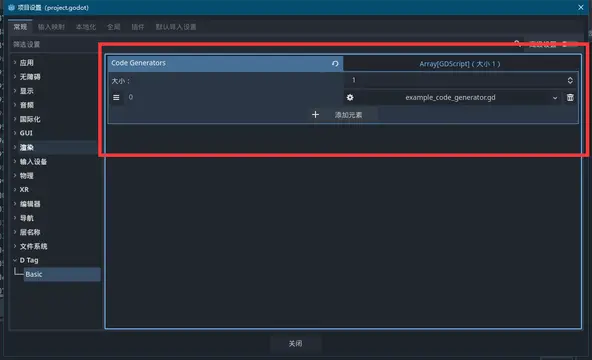
You can add custom code generators through the "DTag/basic/code_generators" option in project settings, such as generating C# definition scripts for DTag.
Custom code generators must be marked as tool scripts and have a generation function with the signature func generate(parse_result: Dictionary[String, EntryDef], redirect_map: Dictionary[String, String]) -> String, returning the generated file path.
EntryDefis the abstract base class ofTagDefandDomainDef, imported fromres://addons/dtag.daylily-zeleen/editor/parser.gd.
Example: (Only print the keys of the parse result as a demonstration. Please refer to "res://addons/dtag.daylily-zeleen/generator/gen_dtag_def_gdscript.gd" for more details)
# res://example/example_generator.gd
@tool

const Parser := preload("res://addons/dtag.daylily-zeleen/editor/parser.gd")
const EntryDef = Parser.EntryDef


func generate(parse_result: Dictionary[String, EntryDef], redirect_map: Dictionary[String, String]) -> String:
 for k in parse_result:
  print(k)

 return ""
DTag, a tool for creating tag like "GameplayTag" in Unreal Engine.
NOTE: This project is still under development, it may undergo significant changes in the future.
DTag,为 Godot 提供一个类似 Unreal Engine 中 GameplayTag 的 Tag 机制。
注意:该项目仍处于开发中,未来可能会发生巨大变化。
Reviews
Quick Information
Godot - DTag
DTag, a tool for creating tag like "GameplayTag" in Unreal Engine.NOTE: This project is still under development, it may undergo significant changes in the future.DTag,为 Godot 提供一个类似 Unreal Engine 中 GameplayTag 的 Tag 机制。注意:该项目仍处于开发中,未来可能会发生巨大变化。
Supported Engine Version
4.5
Version String
1.2.0
License Version
MIT
Support Level
community
Modified Date
1 month ago
Git URL
Issue URL