NeighbourQuery2D
An asset by GeraldKimmersdorfer
Install Asset
Install via Godot
To maintain one source of truth, Godot Asset Library is just a mirror of the old asset library so you can download directly on Godot via the integrated asset library browser
Quick Information

NeighbourQuery2D
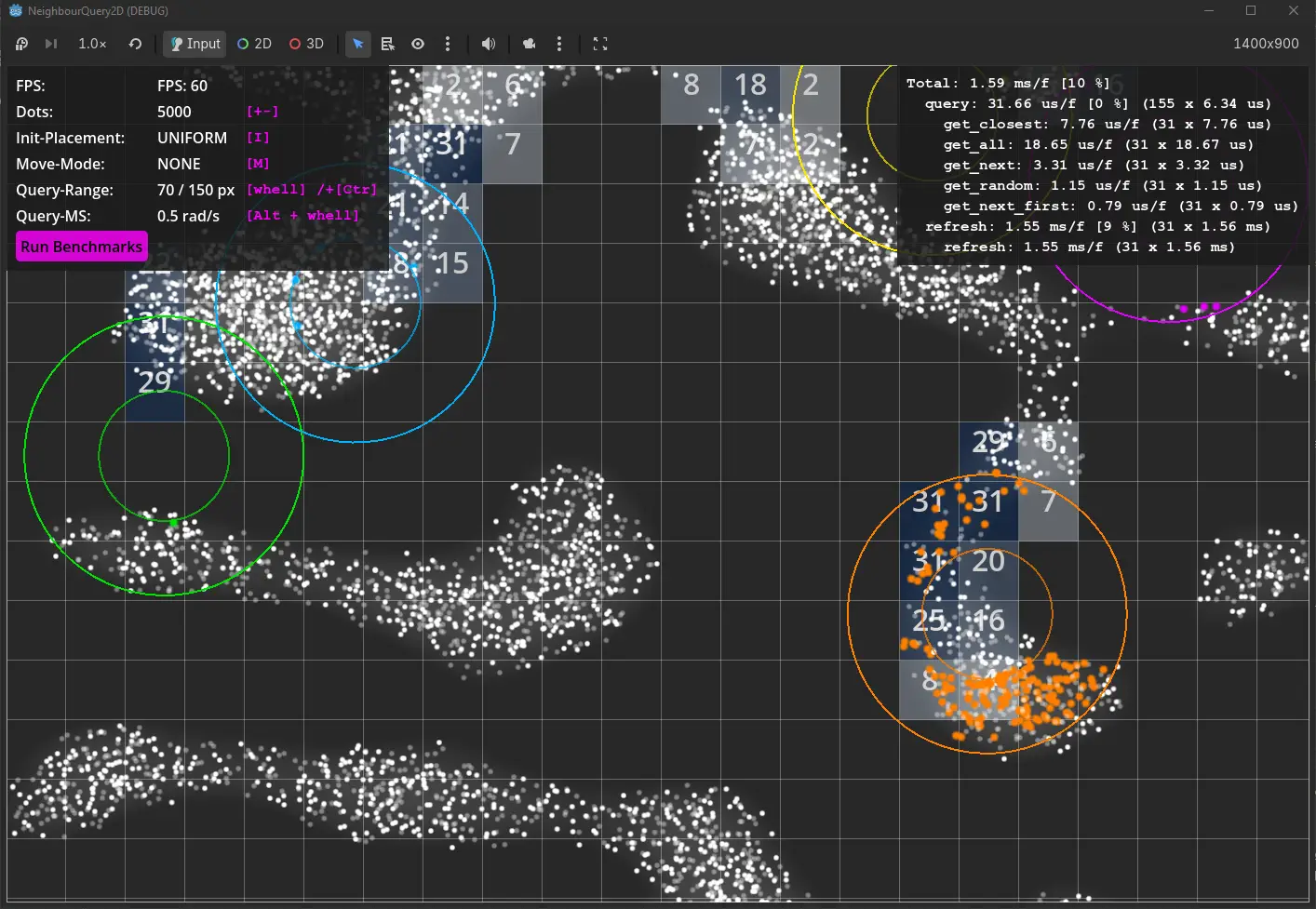
A Godot 4 GDExtension written in C++ that provides lightning fast 2D spatial queries for nodes in a scene. It maintains a uniform grid refilled on the physics tick (at adjustable time intervals). It lets you efficiently query nodes by their position offering functions like: get_closest(...), get_random(...), get_next(...),...Check the github repository for more information...
Supported Engine Version
4.6
Version String
0.9
License Version
MIT
Support Level
community
Modified Date
4 months ago
Git URL
Issue URL
 NeighbourQuery2D


A Godot 4 GDExtension that provides fast 2D spatial queries for nodes in a scene. It maintains a uniform grid refilled on the physics tick (at adjustable time intervals). It lets you efficiently find nodes nearby.
Derived from the godot-cpp GDExtension template.
What it does
NeighbourQuery2D is a Node2D you add to your scene. Other nodes register themselves as subscribers. You can then query by world position:
get_next(position, max_distance, min_distance, layer_mask, exclude)Returns the nearest subscriber within range.get_next_first(position, max_distance, min_distance, layer_mask, exclude)Returns the first subscriber found within range. Faster thanget_nextsince it stops at the first valid hit without searching for the closest.get_random(position, max_count, max_distance, min_distance, layer_mask, exclude)Returns up tomax_countrandomly selected subscribers within range.get_all(position, max_distance, min_distance, layer_mask, exclude)Returns all subscribers within range.get_closest(position, max_count, max_distance, min_distance, layer_mask, exclude)Returns up tomax_countnearest subscribers within range.
The grid (adjustable via domainand grid_size) gets refilled every physics frame by default, but that can be throttled (refresh_intervall). Query results then may not be accurate, but they do promise that all of the resulting Nodes are alive.
The domain and grid cell size are adjustable via properties in the editor.
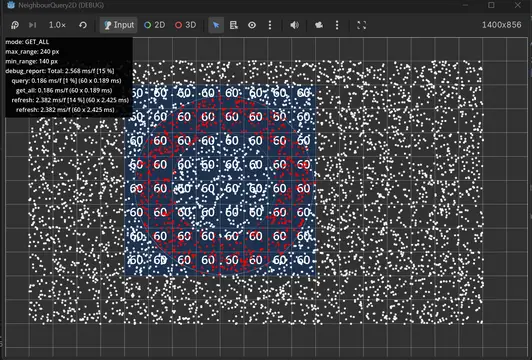
In debug builds the node emits a debug_info signal each physics frame with a debug_report string containing per-function timings, frame budget percentages, and call counts.
Check the Godot documentation for more details.
Usage-Setup
1. Download the latest release
Get the latest release from the Releases page.
2. Add to your project
Move the neighbour-query-2d folder into your project's addons/ folder. No plugin activation is necessary.
3. Add the node to your scene
Place a NeighbourQuery2D node in your level scene. In the inspector, set the domain rect to cover the full level area. Nodes outside the domain are ignored.
4. Subscribe and query Example
extends Node2D

@onready var nq: NeighbourQuery2D = $NeighbourQuery2D

## layers are bitmasks: use powers of 2, combine with | (e.g.
## LAYER_ENEMIES | LAYER_PICKUPS), or pass 0xFFFFFFFF for all
const LAYER_ENEMIES := 1
const LAYER_PLAYERS := 2

func _ready() -> void:
    nq.subscribe(self, LAYER_ENEMIES)

func _exit_tree() -> void:
    # Not strictly necessary after freeing, as it gets auto-removed in that case
    nq.unsubscribe(self)

func _physics_process(_delta: float) -> void:
    # Push away from the 5 closest enemies within 300px
    var push := Vector2.ZERO
    for enemy in nq.get_closest(global_position, 5, 300.0, 0.0, LAYER_ENEMIES, self):
        var offset: Vector2 = global_position - enemy.global_position
        var dist: float = offset.length()
        if dist > 0.0:
            push += offset / dist * (1.0 - dist / 300.0)  # stronger when closer

    # Pull toward the nearest player
    var pull := Vector2.ZERO
    var player: Node2D = nq.get_next(global_position, INF, 0.0, LAYER_PLAYERS, self)
    if player:
        pull = (player.global_position - global_position).normalized()

    global_position += (push + pull) * delta
Development-Setup
[!IMPORTANT] If you only want to use the Extension in your project please download the latest Release (see Usage-Setup). It already contains the compiled library for most targets.
If you want to modify the Extension you'll need the following:
- SCons must be installed and available on your PATH.
- A C++ Compiler (developed with MSVC)
Clone and build:
git clone --recurse-submodules https://github.com/GeraldKimmersdorfer/godot-neighbour-query-2d.git
scons
As a post-build step the compiled library is placed in bin and copied into project/bin/.
Benchmark / Example Project
Import the project/ folder into Godot to test.
A Godot 4 GDExtension written in C++ that provides lightning fast 2D spatial queries for nodes in a scene. It maintains a uniform grid refilled on the physics tick (at adjustable time intervals). It lets you efficiently query nodes by their position offering functions like: get_closest(...), get_random(...), get_next(...),...
Check the github repository for more information...
Reviews
Quick Information
NeighbourQuery2D
A Godot 4 GDExtension written in C++ that provides lightning fast 2D spatial queries for nodes in a scene. It maintains a uniform grid refilled on the physics tick (at adjustable time intervals). It lets you efficiently query nodes by their position offering functions like: get_closest(...), get_random(...), get_next(...),...Check the github repository for more information...
Supported Engine Version
4.6
Version String
0.9
License Version
MIT
Support Level
community
Modified Date
4 months ago
Git URL
Issue URL