A 2D drop-in replacement for the Godot engine that adds stability and fluids. This version is deterministic, just not cross platform deterministic.This version has:- SIMD (Single instruction, multiple data) operations for even faster performance- parallel solving.
A 2D drop-in replacement for the Godot engine that adds stability and fluids. This version is cross platform deterministicThis version does NOT have:- SIMD (Single instruction, multiple data) operations for even faster performance- parallel solving.This version is more an advanced version and it's not for normal use cases.
Adds a Node for rendering multiple layered textures on top of each other. Supports variants and modulates per-layer, and animations.
This is a proof of concept project that demonstrates how to setup an object that can be manipulated via multi-touch. This includes setting textures externally, setting a starting bounding size, and setting a click-mask for more intuitive objects with transparency.While this repo is intended mostly as example code, I have attempted to structure it to be usable as an addon. I do not promise to provide support or continue development, but welcome merge requests and forks.I've also included a module for emulating multi-touch via mouse. Click anywhere to create a touch point. Click and drag to move the touch points around. Right click on a point to delete it. Right click outside a touch point to delete all touch points.
Implementation of BulletML, a danmaku description language.Includes 2 new nodes, BulletMLBulletInstance and BulletMLBulletEmitter. BulletMLBulletInstance can be extended to create bullets or enemies to be spawned through BulletML scripts, and BulletMLBulletEmitter takes in a BulletML script filename and runs it.
a JRPG turn based combat system that is supposed to be a drop in solution for godot 4.6
A Camera2D inheriting node that allows for an attached Window node to have it's screen position and size corelate exactly to this node's global_position and camera size.This supports both embedded and native windows, and allows for the screen offsets to be relative to the virtual screen space or the SceneTree.root. This also ensures that the positioning and resizing of the window works both ways, allowing for full use of the native OS's window handles.Due to heavy implementation changes introduced in Godot-Spyglass v2, Godot-Spyglass v2 is not backward compatible with Godot-Spyglass v1. This also means that compatibility with Godot v4.5 is no longer supported.
To support large game worlds without sacrificing performance, I developed a chunk loading system for my game and I want to share that technology with you.As the player moves through the world, the system continuously determines which chunks should exist based on a configurable loading radius.The chunk loader supports dynamic streaming of TileMapLayer tile data. When a chunk enters the active range, its tile data is loaded into the appropriate TileMapLayers. When a chunk leaves the active range, its tiles are removed from memory.This allows the game to render only the terrain surrounding the player instead of loading the entire world at once. The result is significantly lower memory usage and improved performance, even with large open worldsIn addition to terrain streaming, the system supports loading and unloading scenes as resources. Each chunk contains references to scene resources representing world objects.When a chunk becomes active, the associated scene resources are instantiated and added to the world. When the chunk is unloaded, those instances are automatically removed.Because objects are stored as resource references rather than permanently existing in the scene tree, thousands of potential world objects can be managed while only a small subset remains active at any given time.
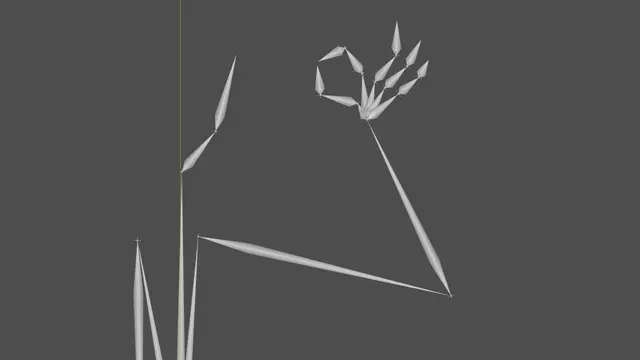
# Human 2D Skeleton RigContains a `Skeleton2D` with bones for limbs, including toe and hands with 5 fingers.There is also a scene with some example animations with `Polygon2D`.Meet me at the Scalable Vector Shapes 2D Discord Server: https://discord.gg/CDdkVvT2Ff## Ease of useTo make the skeleton's `Bone2D` gizmo's easier to see and manipulate, adapt its `Bone Width` and `Bone Outline Size` via `Editor Settings > Editors > 2D`.
MetroCamera2D is a subclass of Camera2D that allows the user to define regions of the world that can constraint and override the camera's settings individually.Constraints can have different forms:- Area defined by a Shape2D or a Polygon2D- Fixed path defined by a Path2D node- Fixed point defined by a Marker2DOther supported features include: offseting, smooth interpolation, mouse-based look-ahead ...
Create custom easing curves for tween interpolation.
A tool for lossless compression of sprites with identical regions.Use SpriteDicing to split a set of sprite textures into units, discard identical ones, bake unique units into atlas textures to then seamlessly reconstruct the original sprites at runtime, without actually keeping original textures in the build.The solution significantly reduces build size when multiple textures with identical areas are used.