Godot Scene Painter adds basic text painting functionality for development directly into the Godot 2D scene editor with zero runtime cost. Just press the new paint button in the toolbar, and you can:- Leave notes for yourself or teammates.- Sketch out ideas right where you want them.- Plan out levels in advance.- Do a bunch of other stuff I can't think of off the top of my head.See Github repository for more information.
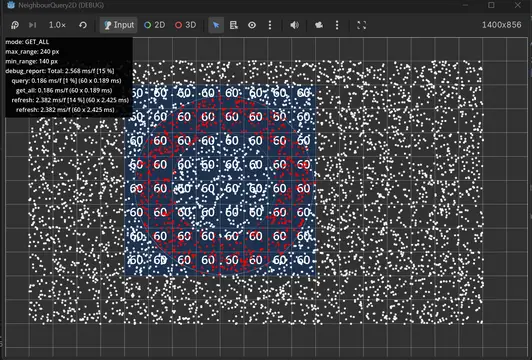
A Godot 4 GDExtension written in C++ that provides lightning fast 2D spatial queries for nodes in a scene. It maintains a uniform grid refilled on the physics tick (at adjustable time intervals). It lets you efficiently query nodes by their position offering functions like: get_closest(...), get_random(...), get_next(...),...Check the github repository for more information...
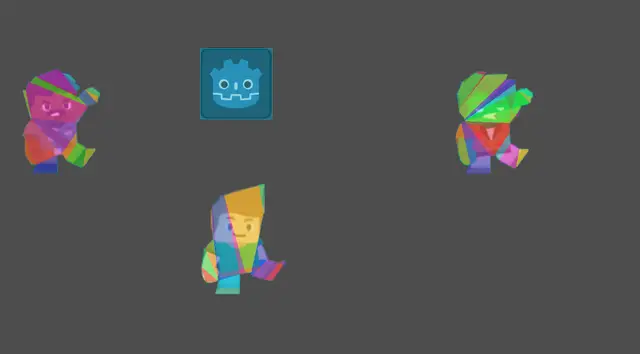
Provides a Sprite2D node that auto generates its custom collision polygon shape.
A 2D drop-in replacement for the Godot engine that adds stability and fluids. This version is cross platform deterministicThis version does NOT have:- SIMD (Single instruction, multiple data) operations for even faster performance- parallel solving.This version is more an advanced version and it's not for normal use cases.
SpringBody2D adds a trampoline-like physics node to Godot 4, producing elastic bounce reactions when RigidBody2D objects collide with it. Unlike standard high-restitution collisions which reflect velocity instantly, SpringBody2D accumulates energy during impact and releases it as an outward impulse on separation — creating a weighted, physically satisfying bounce from dropped or flung objects without requiring direct user input.Nodes are customizable with properties for bounce intensity and responsiveness, and can be combined with each other and other physics bodies for varied interactions.Enable via Project → Project Settings → Plugins → SpringBody2D
A Camera2D inheriting node that allows for an attached Window node to have it's screen position and size corelate exactly to this node's global_position and camera size.This supports both embedded and native windows, and allows for the screen offsets to be relative to the virtual screen space or the SceneTree.root. This also ensures that the positioning and resizing of the window works both ways, allowing for full use of the native OS's window handles.Due to heavy implementation changes introduced in Godot-Spyglass v2, Godot-Spyglass v2 is not backward compatible with Godot-Spyglass v1. This also means that compatibility with Godot v4.5 is no longer supported.
Draws a dashed polyline with per-segment width and color control.1.0.1ADDED .gitattributes
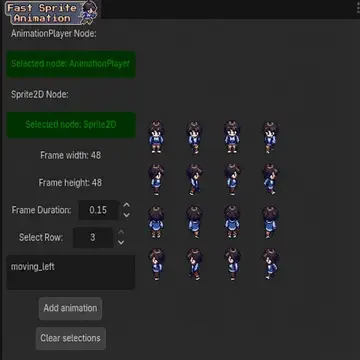
A Godot editor tool that streamlines the creation of frame-based animations from sprite sheets.
A lightweight real-time dialogue manager for Godot 4.
A Basic Scale and Margin calculations tool for Godot.1) Scale tool:* "How much to scale by": Calculates the target scale based on original dimensions and the target minimum (or maximum) size in pixels for either width or height* "What are the new dimensions of the sprite once scaled": Calculates the dimensions based on a given scale2) Margin tool:* "Where to put the item based on margins": Calculates where the (center of) the sprite should be, based on the margins/distance to a defined reference position and direction(I put those two tools together because I personally need to use both at the same time for my own game).
Create custom easing curves for tween interpolation.
DragDrop2D is a simple GDScript framework to allow the player to drag/drop CharacterBody2Ds around.