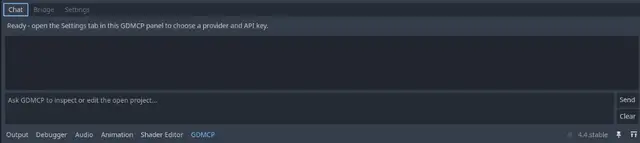

GDMCP is a Godot 4 editor plugin that connects AI agents to your project through the Model Context Protocol (MCP).Use it with Cursor, Claude Desktop, or other MCP clients to inspect and edit scenes, nodes, scripts, and files. It also includes an optional in-editor chat panel that works with Anthropic (Claude), OpenAI, Google Gemini, and OpenAI-compatible providers using your own API keys.Features:- Localhost MCP WebSocket bridge for AI tools- Scene tree inspection and undoable node edits- Read/write project files and attach scripts- Run/stop the project from the agent- Optional in-editor AI chat with multiple providersRequires Godot 4.2+. The optional Cursor/Claude MCP server needs Node.js 20+.Author: Dhruv VineshLicense: MIT
Kickstart Projects with Free Godot Assets
Discover high quality and Open Source assets for your next Godot project
Popular with the community
View all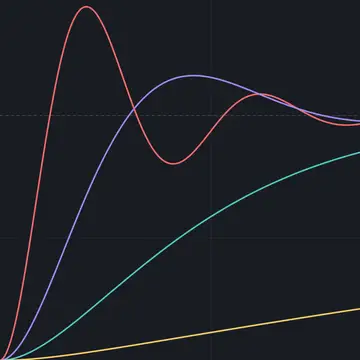

Spreen provides a Tween-like API for animation and interpolation using springs as a base. Unlike TRANS_SPRING in the Tween library, these springs are defined by damping ratios and halflife.These help you make fantastic character and camera controllers, reacting to user input in very natural ways.


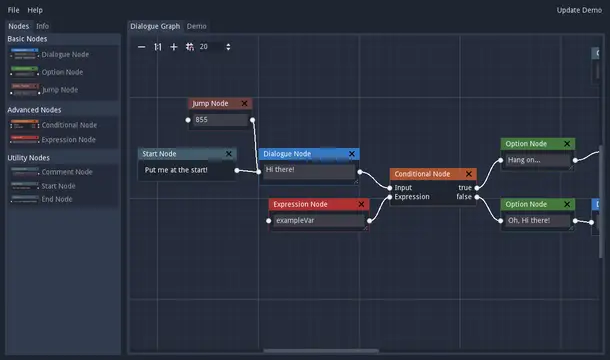
A simple branching dialogue editor and stateless runtime.Create your dialogue right in the Godot Editor itself with a simple script-like language and the built-in syntax checker.Then, in your game, use the DialogueManager global to fetch lines of dialogue. There is an example dialogue balloon to help get you started on creating your own to fit in better with your game. The GitHub repository also contains a few extra example balloon implementations.


Synchronize an animation player position with a position input value.This forces a transition between points in the animation rather than sudden jumps due to erratic position inputs.The demo shows an HSlider being used to move a Sprite whose position is determined by an animation track.


A simple car demo to help you make your own cars in godot 4.0 .Just import the cars folder and drop Doge.tscn in your scene.


A GDScript addon to interact with a Telegram Bot in Godot Engine.


Adds jiggle physics to a Skeleton3D bone using SkeletonModifier3D nodes.DMWBWiggleRotationModifier3D: Rotates the bone around the current bone pose. The current pose direction acts as the spring's rest position.DMWBWigglePositionModifier3D: Moves the bone around the current bone pose without rotating. The current pose position acts as the spring's rest position.


# DER AntiCheat v2.3.0 Official Documentation# DER AntiCheat v2.3.0 官方文档---## Version Information / 版本信息| | ||---|---|| **Version / 版本** | 2.3.0 || **Godot Version / 适配引擎** | 4.6+ || **Author / 作者** | 222 || **License / 协议** | MIT |---## Overview / 概述### EnglishDER AntiCheat v2.3.0 focuses on developer experience, introducing a one-click preset system, an in-game debug panel, and mobile compatibility guarantees. This release makes enterprise-grade anti-cheat accessible to developers of all skill levels. Choose from Light, Standard, or Competitive presets, or use `quick_setup()` to get started in seconds. The new In-Game Debug Panel (Ctrl+Shift+F12) provides real-time module status, runtime toggle, and live log viewing. The suite now offers **43 integrated modules** with full Android and iOS support.### 中文DER AntiCheat v2.3.0 专注于开发者体验,引入了一键预设系统、游戏内调试面板和移动端兼容性保证。本次发布让企业级反作弊对任何水平的开发者都触手可及。选择轻量、标准或竞技预设,或使用 `quick_setup()` 在几秒内启动。新的游戏内调试面板 (Ctrl+Shift+F12) 提供实时模块状态、运行时开关和实时日志查看。该套件现在提供 **43 个集成模块**,完整支持 Android 和 iOS。---## New in v2.3.0 / v2.3.0 新增### 1. Protection Preset System / 预设配置系统**English**One-click setup with three preset configurations tailored for different game types.- **Light Preset (6 modules):** Basic memory encryption and speed hack detection for single-player games- **Standard Preset (15 modules):** Injection detection, anti-debug, and save protection for multiplayer games- **Competitive Preset (38 modules):** Full protection suite for ranked matches and esports- **quick_setup() API:** Start protection with a single function call- **Inspector Editing:** All preset parameters editable in the Godot Inspector panel**中文**一键设置,三种针对不同游戏类型的预设配置。- **轻量预设 (6 模块):** 单机游戏的基础内存加密和加速检测- **标准预设 (15 模块):** 多人游戏的注入检测、反调试和存档保护- **竞技预设 (38 模块):** 排位赛和电竞的完整防护套件- **quick_setup() API:** 通过单个函数调用启动保护- **Inspector 编辑:** 所有预设参数可在 Godot Inspector 面板中编辑---### 2. In-Game Debug Panel / 游戏内调试面板**English**Runtime debug overlay accessible via Ctrl+Shift+F12, providing real-time monitoring and control.- **Module Status Dashboard:** Green/yellow/red indicators for all 38 modules- **Runtime Toggle:** Enable or disable individual modules during gameplay- **Live Log Viewer:** Last 100 log entries with real-time updates- **Stats Dashboard:** FPS, memory usage, process ID, and module statistics- **Password Protection:** Secure access control for release builds- **Hotkey:** Default Ctrl+Shift+F12 (configurable)**中文**通过 Ctrl+Shift+F12 访问的运行时调试浮层,提供实时监控和控制。- **模块状态仪表板:** 所有 38 个模块的绿/黄/红指示灯- **运行时开关:** 在游戏过程中启用或禁用单个模块- **实时日志查看器:** 最近 100 条日志条目,实时更新- **统计仪表板:** FPS、内存使用、进程 ID 和模块统计- **密码保护:** 发布版本的安全访问控制- **快捷键:** 默认 Ctrl+Shift+F12(可配置)---### 3. Mobile Compatibility / 移动端兼容**English**Full Android and iOS support confirmed with performance optimizations for mobile devices.- **ARM64 Native:** All detection modules tested on ARM64 architecture- **Low Overhead:** Object pooling and thread management optimized for battery life- **Touch Input:** Debug panel fully functional with touch interactions- **GPU Efficiency:** Minimal GPU impact during security scans**中文**完整的 Android 和 iOS 支持,针对移动设备进行性能优化。- **ARM64 原生:** 所有检测模块在 ARM64 架构上测试通过- **低开销:** 对象池和线程管理针对电池寿命优化- **触摸输入:** 调试面板完整支持触摸交互- **GPU 效率:** 安全扫描期间最小化 GPU 影响---## What's New in v2.2.0 / v2.2.0 新增### New Security Modules / 新增安全模块| Module / 模块 | Class | Description / 描述 ||:---|:---|:---|| Speed Detector V2 | DERSpeedDetectorV2 | Time-based speed hack detection with multi-level sensitivity / 基于时间的加速器检测,支持多级灵敏度 || Virtual Position Detector | DERVirtualPosDetector | GPS spoofing detection for location-based games / 面向位置游戏的 GPS 伪造检测 || File Integrity Scanner | DERFileIntegrity | SHA256 game file verification with auto-repair / SHA256 游戏文件验证,支持自动修复 || Offline Protector | DEROfflineProtector | Offline violation caching with auto-flush / 离线违规缓存,支持自动刷新 || Log Encryptor | DERLogEncryptor | AES-256-CBC encrypted log storage / AES-256-CBC 加密日志存储 |---## What's New in v2.1.0 / v2.1.0 新增| Module / 模块 | Class | Description / 描述 ||:---|:---|:---|| CCU Optimizer | DERCCUOptimizer | Dynamic quality scaling based on player count and FPS / 基于玩家数量和帧率的动态画质缩放 || Consistency Validator | DERConsistencyValidator | Server-client state validation with 5 violation actions / 服务器-客户端状态验证,5 种违规处理 || False Positive Filter | DERFalsePositiveFilter | Device-tier based false positive reduction / 基于设备档位的误报过滤 || Cloud Snapshot | DERCloudSnapshot | Encrypted cloud save sync with conflict resolution / 加密云存档同步,支持冲突解决 || Whitelist Manager | DERWhitelistManager | Hardware ID + device fingerprint whitelist / 硬件 ID + 设备指纹白名单 || Encrypted Logger | DEREncryptedLogger | AES-256-CBC encrypted logging with auto-upload / AES-256-CBC 加密日志,支持自动上传 || Device Fingerprint | DERDeviceFingerprint | Cross-platform hardware fingerprinting / 跨平台硬件指纹 |---## Quick Start / 快速上手```gdscript# One-Click Setup (New in v2.3.0) / 一键设置 (v2.3.0 新增)DERAntiCheat.quick_setup("competitive") # Light / Standard / Competitive# Or load a preset / 或加载预设DERAntiCheat.load_preset("standard")# In-Game Debug Panel / 游戏内调试面板# Press Ctrl+Shift+F12 during gameplay / 游戏时按 Ctrl+Shift+F12# Speed Detector V2 / 加速器检测 V2 (v2.2.0)var speed_detector = DERSpeedDetectorV2.new()speed_detector.speed_hack_detected.connect(func(ratio, details): print("Speed hack detected! Ratio: ", ratio))func _process(delta): speed_detector.process_frame(delta)# Virtual Position Detector / GPS 伪造检测 (v2.2.0)var pos_detector = DERVirtualPosDetector.new()pos_detector.location_fake_detected.connect(func(details): print("GPS spoof detected!"))# File Integrity Scanner / 文件完整性扫描 (v2.2.0)var integrity = DERFileIntegrity.new()integrity.save_manifest("user://file_manifest.json")integrity.start()```---Performance Comparison / 性能对比Metric / 指标 v1.9.0 v2.0.0 v2.1.0 v2.2.0 v2.3.0Memory Usage / 内存占用 200MB 100MB 95MB 92MB 90MBStartup Time / 启动时间 500ms 300ms 280ms 260ms 250msScan Lag / 扫描卡顿 50ms 20ms 18ms 15ms 12msGC Pauses / GC 暂停 10ms 3ms 3ms 2ms 2msTotal Modules / 模块总数 28 31 38 43 43---Available Presets / 可用预设Preset / 预设 Modules / 模块 Best For / 适用场景Light / 轻量 6 Single-player games, prototypes / 单机游戏、原型开发Standard / 标准 15 Most multiplayer games / 大多数多人游戏Competitive / 竞技 38 Ranked matches, esports, high-value economies / 排位赛、电竞、高价值经济---Security Features Summary / 安全功能总览Feature / 功能 v2.1.0 v2.2.0 v2.3.0Protection Presets / 预设配置 No No YesIn-Game Debug Panel / 游戏内调试面板 No No YesQuick Setup API / 快速设置 API No No YesMobile Compatibility / 移动端兼容 No No YesSpeed Detector V2 / 加速器检测 V2 No Yes YesVirtual Position Detector / GPS 伪造检测 No Yes YesFile Integrity Scanner / 文件完整性扫描 No Yes YesOffline Protector / 离线违规缓存 No Yes YesLog Encryptor / 日志加密存储 No Yes YesMemory Encryption / 内存加密 Yes Yes YesThread Pool / 线程池 Yes Yes YesInject Detection / 注入检测 Yes Yes YesVM Detection / 虚拟机检测 Yes Yes YesAnti-Debug V2 / 反调试 V2 Yes Yes YesRollback Detection / 回滚检测 Yes Yes Yes---License / 协议MIT License — Free for personal and commercial use.MIT 协议 — 免费用于个人和商业用途。---Made with dedication for the Godot community为 Godot 社区倾力打造
Assets we Love
View allAdds jiggle physics to a Skeleton3D bone using SkeletonModifier3D nodes.DMWBWiggleRotationModifier3D: Rotates the bone around the current bone pose. The current pose direction acts as the spring's rest position.DMWBWigglePositionModifier3D: Moves the bone around the current bone pose without rotating. The current pose position acts as the spring's rest position.

A simple branching dialogue editor and stateless runtime.Create your dialogue right in the Godot Editor itself with a simple script-like language and the built-in syntax checker.Then, in your game, use the DialogueManager global to fetch lines of dialogue. There is an example dialogue balloon to help get you started on creating your own to fit in better with your game.

Quake .map file support for Godot.Qodot extends the Godot editor to import Quake .map files, and provides a data-driven framework for converting the entities and brushes contained therein into a custom node hierarchy.

Explore more from Categories
Featured Categories
Featured Category
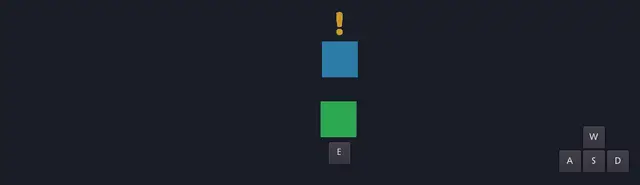
2D Tools:
Enhance your 2D experience
Featured Category
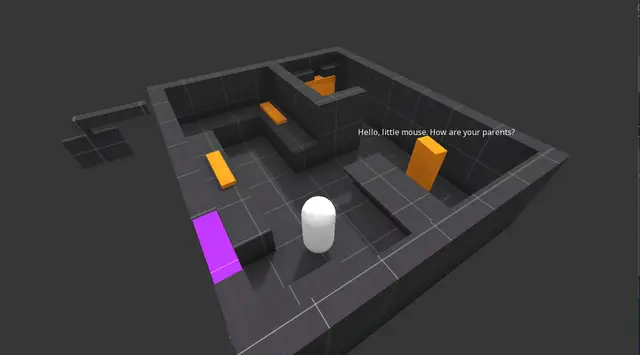
3D Tools:
Level up your 3D world
Featured Category
Tools:
More Tools for a better Editor
Newly Updated
View allSpreen provides a Tween-like API for animation and interpolation using springs as a base. Unlike TRANS_SPRING in the Tween library, these springs are defined by damping ratios and halflife.These help you make fantastic character and camera controllers, reacting to user input in very natural ways.
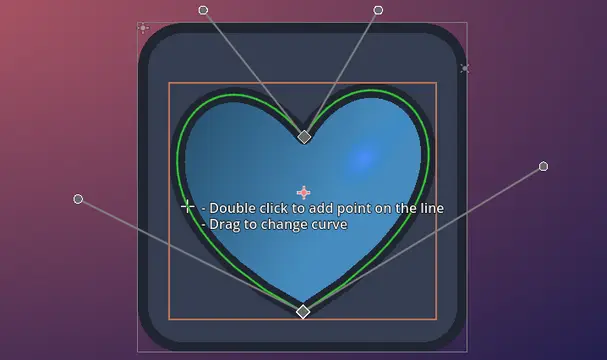

Scalable Vector Shapes 2D lets you do 3 things:- Draw Crisp Vector Strokes, Fills and Collisions using a Path Editor inspired by the awesome Inkscape- Animate Curves of your Vector Shapes and deform them using Skeleton2D- Import .svg files as seamless Vector Shapes in stead of as raster imagesAsk questions on discord:https://discord.gg/CDdkVvT2FfChangelog: https://github.com/Teaching-myself-Godot/ez-curved-lines-2d/blob/master/CHANGELOG.md


Cross-platform in-app purchase plugin following the OpenIAP specification.Features:• Unified API for iOS (StoreKit 2) and Android (Google Play Billing 8+)• Type-safe GDScript API with auto-generated types• Supports consumables, non-consumables, and subscriptions• OpenIAP standard compliance for consistent behavior across platforms
GDMCP is a Godot 4 editor plugin that connects AI agents to your project through the Model Context Protocol (MCP).Use it with Cursor, Claude Desktop, or other MCP clients to inspect and edit scenes, nodes, scripts, and files. It also includes an optional in-editor chat panel that works with Anthropic (Claude), OpenAI, Google Gemini, and OpenAI-compatible providers using your own API keys.Features:- Localhost MCP WebSocket bridge for AI tools- Scene tree inspection and undoable node edits- Read/write project files and attach scripts- Run/stop the project from the agent- Optional in-editor AI chat with multiple providersRequires Godot 4.2+. The optional Cursor/Claude MCP server needs Node.js 20+.Author: Dhruv VineshLicense: MIT


A lightweight and visual Resource database manager for Godot 4.x. It provides a dedicated dock panel to scan, manage, and edit custom Resources (`.tres`) in a centralized grid table, serving as a powerful complement to the native Inspector.**Key Features:**- **Grid Data View:** View and edit properties across multiple resources of the same class side-by-side.- **Large Text Editor:** A built-in multi-line text window with word wrap, perfect for editing long lore or item descriptions.- **Visual Array Editor:** Easily add, modify, and remove elements within arrays.- **Script Injector Wizard:** Add new `@export` variables or groups to your custom Resource scripts directly via UI, no manual coding required.- **Localization:** Built-in English and Simplified Chinese UI (can automatically follow the editor's language).

Actually good first person controller for the Godot Engine. MIT License (credit Colormatic Studios)This first person controller was made because there weren't many first person controllers for Godot at the time, and the ones that did exist were pretty bad.It is highly customizable and comes with many features, QOL, and readable code.Move with WASD, space to jump, shift to sprint, C to crouch.FEATURES: In-air momentum Motion smoothing FOV smoothing Head bobbing Crouching Sprinting 2 crosshairs/reticles, one is animated (more to come?) Controller/GamePad support (enabled through code, see wiki) In-editor tools (enable editable children to use)If you make a cool game with this addon, I would love to hear about it!Check out the Colormatic Git page for a wiki and more.https://git.colormatic.org/ColormaticStudios/quality-godot-first-person
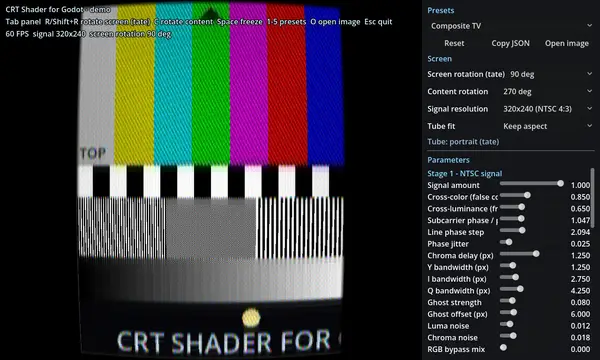

- Not a look-alike filter: it builds a real NTSC signal, degrades it as RF reception, then demodulates. Artefacts are by-products.- Phosphor mask: slot, aperture grille or shadow mask.- RF loss: tuning error, phase noise, sync jitter, snow, AGC wobble.- Beam misalignment and curvature give a real tube's false colour.- Interlaced even/odd fields.- Vertical (tate) games rotate the whole plane, scanlines and mask.- No frame drops in normal use.- Drop-in node, 48 parameters, 5 presets, MIT.

SELODEV Free Starter KitA small, finished top-down game you can press Play on, plus every free SELODEV Lite system already sitting in the project. No coding required.The game is the same one from the Free Starter: walk around, talk to the Healer, take a quest, gather three herbs, save. What's different is what comes with it.Fourteen systems are in `addons/`, waiting for when your game needs one.Play it (Godot 4.3 or newer)Open this folder in Godot and press **Play (F5)**.- **Move:** arrow keys or WASD- **Talk:** walk up to the Healer, the green one, and press **Space** or **Enter**- **Gather** the three herbs that light up- **Save and Load:** buttons at the top rightThat loop of talk, quest, collect, save is a real game. The part that normally needs a programmer, wiring the systems into each other, is already done for you in the `content/` data files.Start HereWhen the project opens, look for the **Start Here** tab on the right, next to the Inspector. It's a four-item list that ticks itself off as you work, and it holds the switches for all fourteen systems. If you read one thing, read that panel.The fourteen systemsThree are switched on out of the box, because the story game uses them:| On | System | What it does ||---|---|---|| yes | Dialogue | Conversations with choices || yes | Quests | Objectives that track and complete || yes | Save / Load | Save slots that survive quitting || | Controller | Walking, jumping, press-E on things || | Inventory | Carrying items, stacking, weight || | Equipment | Wearing gear that changes your stats || | Loot | What a chest or enemy drops, and how often || | Crafting | Turning items into other items || | Vendor | A shop that buys and sells || | Stats / Skills | Health, damage, levels, skill points || | Combat | Hitboxes, damage, dying || | Enemy AI | Enemies that notice you, chase, give up || | Scene Flow | Doors between rooms, spawn points, checkpoints || | Audio | Music that crossfades, sound effects, audio zones |The other eleven ship switched off on purpose. Each one adds a tab beside the Inspector, and fourteen of them fills that tab bar well past the point where you can read it. Turn one on from Start Here when you want it, or from Project Settings then Plugins if you prefer. Switching one off deletes nothing.## What's inside- `content/*.json` is the game's data, the conversation and the quest. Edit these to change the game. No scripts involved.- `game/` is the world, the player, the NPC, the herb pickups.- `chassis/` is the glue that boots the systems from `content/`. You won't need to touch it.- `addons/` holds the fourteen Lite systems and their no-code editor docks.- `tools/` holds the automated checks, one folder per system.The `.orig` files beside `content/dialogue.json` and `content/quests.json` are the copies that shipped. Start Here compares against them to work out whether you've edited anything yet, so leave them where they are and the checklist keeps working.## Run the checks yourselfEvery system carries a headless test suite:```bashgodot --headless --path . tools/dialogue_lite/verify.tscn```Swap the folder name for any other system. `tools/starter_kit/verify.tscn` checks the Start Here panel itself.Growing out of the Lite tierEach Lite system is the free cut of a paid one. When you hit a wall, the full version drops into the same place and speaks the same event bus, so nothing has to be rebuilt. The full catalogue is at https://selodev.itch.io.## Make it yoursSee **MAKE-IT-YOURS.md**. The short version: change the words in `content/`, swap the coloured squares for your art, and switch on whatever system your idea needs.LicenseMIT. Make it, rename it, ship it, sell it. That's the point.
Guides & Tutorials
View allHow to Install Godot Assets
A step-by-step guide to installing Godot assets from the Asset Library, covering plugins, shaders, scripts, templates and complete projects.
How to Install and Enable Godot Plugins
Everything you need to know about installing Godot editor plugins and add-ons, enabling them in Project Settings, and wiring up autoloads and nodes.
How to Use Shaders in Godot
A practical introduction to using Godot shaders and materials in your project, from applying a shader to a node to tuning parameters and combining effects.
Best Godot 4 Plugins for Faster Development
A curated roundup of high-quality Godot 4 plugins — from editor tools and dialogue systems to AI helpers and input utilities — to speed up your workflow.